
Need help? Text us and our team of experts will reply in minutes +1 949-694-6162
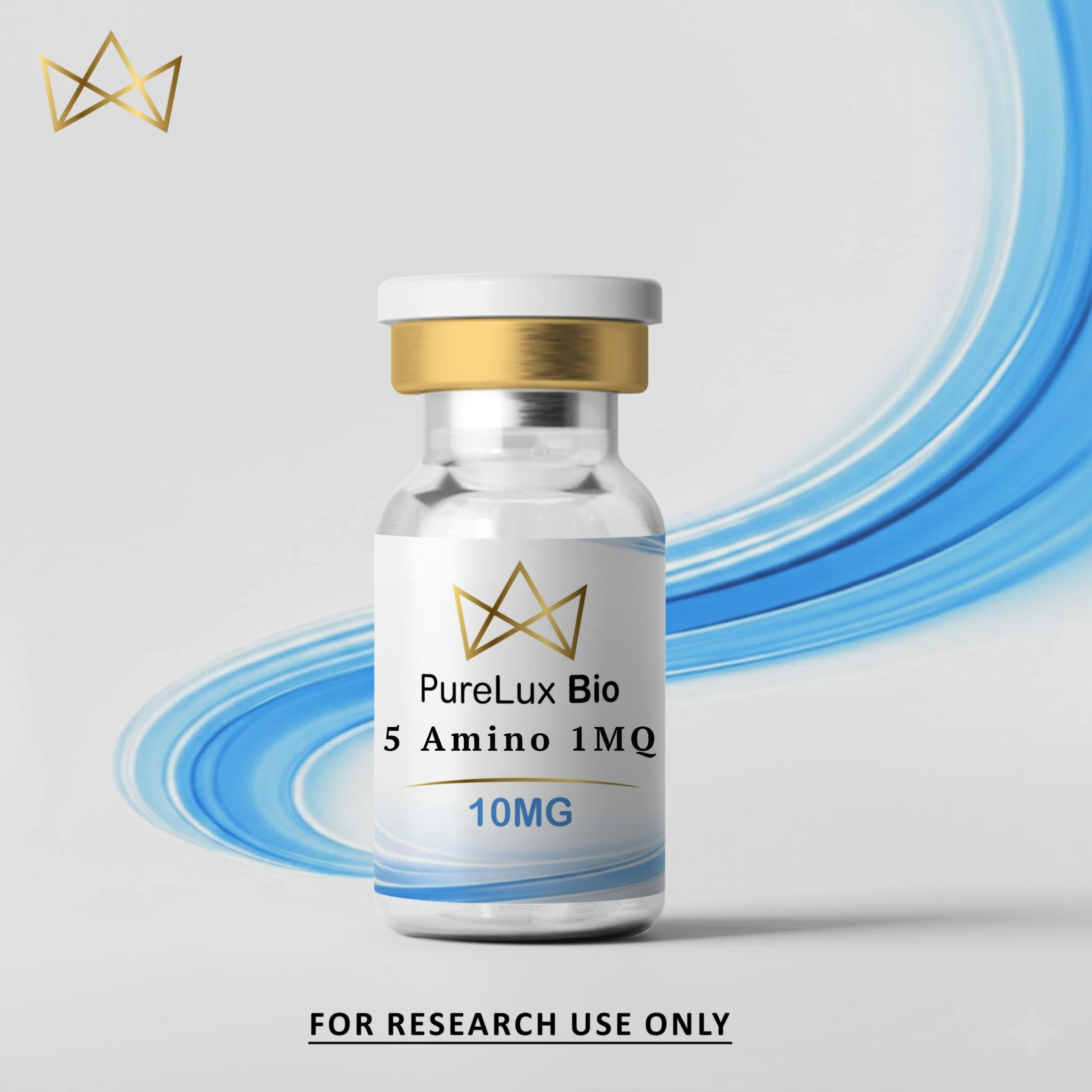
V251230-9-019
$89.99
All products are intended solely for laboratory research and are not for human or animal consumption. By purchasing, the buyer agrees to use these products in compliance with all applicable laws.
Third-party tested for 99% purity, ID, quantity.
Third-party tested for endotoxins

5-Amino-1-MQ has been comprehensively evaluated across metabolic, structural, and physiological aging models, demonstrating unique activity in blocking NNMT pathways, elevating intracellular NAD+ availability, and preserving sirtuin-1 signaling dynamics. Studies evaluate its direct capacity to accelerate fat loss, decrease tissue adiposity, and improve hepatic steatosis baseline vectors in animal models under high-fat dietary conditions. Furthermore, research notes its critical role in stimulating muscle stem cells to enhance functional tissue repair mechanisms.
Key Areas of Research:
Signaling: NNMT enzyme inhibition, NAD+ salvage regulation, sirtuin-1 pathway preservation
Metabolic: Lipogenesis reduction, intracellular adipocyte modification, energy expenditure regulation
Structural: Muscle stem cell (muSC) differentiation, functional tissue proliferation, myogenesis acceleration
Systemic: Hepatic steatosis correction tracking, insulin sensitivity dynamics, metabolic resilience mapping
Together, these investigations reveal 5-Amino-1-MQ’s profound ability to alter tissue-specific metabolic adaptation via enzyme pathway modulation. As a non-peptide small molecule, it provides a highly reliable biochemical foundation for analyzing the intricate interplay between cellular methylation balance, fat deposition, and functional performance limits. By blocking systemic metabolic brakes, 5-Amino-1-MQ delivers a distinct and versatile framework for probing energetic cellular resilience within experimental boundaries. https://www.sciencedirect.com/science/article/pii/S000629521830138X
Neelakantan H. et al. (2018). Small molecule nicotinamide N-methyltransferase inhibitor activates senescent cutaneous cells and accelerates wound healing. Biochemical Pharmacology, 147:141-152. URL: https://pubmed.ncbi.nlm.nih.gov/29672274/
Neelakantan H. et al. (2019). Nicotinamide N-methyltransferase inhibition reverses diet-induced obesity in mice. Molecular Metabolism, 21:12-23. URL: https://www.ncbi.nlm.nih.gov/pmc/articles/PMC6021245/
Brightwell C.R. et al. (2022). NNMT inhibition boosts senescent muscle stem cell activation and enhances physical performance during sarcopenia. Journals of Gerontology Series A, 77(11):2155-2164. URL: https://pubmed.ncbi.nlm.nih.gov/35325121/
STEP 1
Precision Lyophilization
Manufactured in a controlled U.S. facility under strict compounding standards.
STEP 2
Verified Purity
Every batch third-party tested with HPLC and mass spectrometry.
STEP 3
Same-Day Fulfillment
Orders dispatched same-day from our
U.S. facility.
STEP 1
Precision Lyophilization
Manufactured in a controlled U.S. facility under strict compounding standards.
STEP 2
Verified Purity
Every batch third-party tested with HPLC and mass spectrometry.
STEP 3
Same-Day Fulfillment
Orders dispatched same-day from our
U.S. facility.
Everything you need to know about our products and processes.
Each vial contains exactly what’s shown on the label. For example, a 10mg vial has exactly 10mg of lyophilized peptide. Researchers can divide it into smaller portions—like four 2.5mg measurements—but the total amount remains 10mg.